Need for Speed Rivals Announced for Next-Gen Consoles

The next installment in the widely popular car racing franchise Need for Speed, will be available for next-generation platforms, developers Electronic Arts announced.


Need for Speed Rivals is slated for a November 19 release and will be available for PC and current gaming platforms PlayStation 3 and Xbox 360. A version for next-gen consoles PlayStation 4 and Xbox One, neither of which is yet available for sale, will be released later this year.


Unlike the previous installments which were developed solely by Criterion Games, Need for Speed Rivals will be the result of joint work by Criterion and newly formed Ghost Games.


Need for Speed Rivals Announced for Next-Gen Consoles


EA has also released a new trailer for Rivals, which showcases stunning graphics, due to the Frostbite 3 engine around which the game was built. The engine is generally used in first person shooter titles, including EA’s own Battlefield 3. The publisher promised that the jaw-dropping graphics will not be seen only on consoles, but also in the PC version of the game.


Rivals brings a series of new features, most notably what is known as the AllDrive. This new play system allows gamers to easily transition from single player to multiplayer mode, in which they can play alongside their friends without having to exit the game to a menu interface. The game will actually merge your gameplay with your friends’ but you will still be able to choose whether to interact with them or not.


Player will also get to choose whether to play as cops or racers, facing relevant challenges and obtaining rewards specific to their decision. The title marks the return of Autolog, the online Need for Speed community which will allow gamers to compare their results or challenge other players.


Racing fans should also be happy to know that Rivals will see the return of Ferrari to the NFS world, for the first time in seven years. Ghost Games has announced that the Ferrari F12 Berlinetta will be among the world famous models featured in the upcoming game.


Check out the teaser trailer below and tell us what you think of the new Need for Speed installment.


[Image via pushsquare]


The post Need for Speed Rivals Announced for Next-Gen Consoles appeared first on TechBeat.


via TechBeat http://techbeat.com/2013/05/need-for-speed-rivals-announced-for-next-gen-consoles/?utm_source=rss&utm_medium=rss&utm_campaign=need-for-speed-rivals-announced-for-next-gen-consoles

Five steps to ultimate Firefox security

Monkey Light Pro: Animate Your Bike Wheels

We’ve seen the Revolights and how a LED lighting system integrated in your bike’s wheels can be quite a life-saver on the road at night, but this new project is taking the concept of wheel lights even further.


If you want your bike to look like a funky disco ball, you should really try out the Monkey Light Pro system from Northern Carolina company MonkeyLectric. With the light show this system can put on, you’re sure to be spotted by drivers from miles away.


Monkey Light Pro: Animate Your Bike Wheels


The Monkey Light Pro LED system is activated by motion, so it only works while you’re riding your bike, which saves up power. The wheel light system consists of four rows of LEDs, tied together inside the bike wheel. It can be used with almost all common wheel types. The lights are also waterproof, so you won’t have to worry that riding in the rain will damage them.


The system also contains sensors that track the speed and rotation direction, and is based on a phenomenon known as persistence of vision – the flashing LED lights are actually processed into a recognizable image by the human brain. Monkey Light Pro can thus create stable images on your wheels at speeds of 10 to 40 miles per hour.


The entire array weighs about 500 grams and is powered by a 700 mAh lithium polymer battery that can run 3-8 hours at full brightness and about 48 hours at reduced brightness. The lights offer clear visibility in the evening, when it’s overcast and indoors and cannot be seen in bright sunlight.


The system can store up to 1,000 image frames and you can use the companion software provided by MonkeyLectric to create your own playlist, with the images and animations you want, or to choose from the company’s custom artwork, especially created by ten different artists.


MonkeyLectric launched a crowdfunding campaign for the Monkey Light Pro on Kickstarter, with an $180,000 goal. The company is planning to further develop the system and add increased wireless capacities and the possibility of USB charging. Early bidders can get the Monkey Light Pro for $695.


[Image via Kickstarter]


The post Monkey Light Pro: Animate Your Bike Wheels appeared first on TechBeat.


via TechBeat http://techbeat.com/2013/05/monkey-light-pro-animate-your-bike-wheels/?utm_source=rss&utm_medium=rss&utm_campaign=monkey-light-pro-animate-your-bike-wheels

PayPal denies teenager reward for finding website bug

Carbon Electronics Created from Paper

Scientists are always looking for ways to create flexible microchips that are also cost-efficient so as to be used for an ever growing number of applications in the electronics sector. The material of choice is generally plastics, but one of the biggest problems with flexible chips made of plastic or polymers is that they remain sensitive to heat.


This problem seems to have been solved, as researchers with the Max Planck Institute of Germany managed to create conductive graphite structures on paper. Surprisingly, carbon electronics created from paper can withstand temperatures of 800 degrees Celsius (1,472°F).


Carbon Electronics Created from Paper


The idea is not new, as scientists have been trying to find ways to create functional flexible paper circuits for quite some time, given the lost costs and myriad applications of such a development. But the German team has found a simple, elegant method to actually create paper circuits.


Max Planck researchers, led by Cristina Giordano, used a conventional inkjet printer to print a catalyst – iron nitrate, on paper. The catalyst was printed in the shape of the head of Minerva, the Roman goddess of wisdom and Max Planck Institute’s logo.


The paper was then heated to 800 degrees in a nitrogen atmosphere, the absence of oxygen being probably why the paper does not burn in the process. The cellulose in the paper releases water until only pure carbon is left. Due to the iron nitrate catalyst, the printed areas are turned into conductive graphite, while the non-printed areas are just less conductive carbon.


Scientists than proved that the carbon electronics were conductive by electrolytically coating the paper with copper. The copper was deposited only on the Minerva printed design.


paper circuitry

The image illustrates the steps of the process to obtain graphite-based circuitry from paper.


The research team used a similar method to create a 3D conductive structure. They immersed an origami paper crane into the catalyst and heated it until it turned into graphite. The form of the crane was maintained and unlike the 2D design, the entire structure had turned into conductive carbon during the process.


Carbon electronics created from paper can have a wide range of applications and could be easily integrated in the production of electronic devices, due to the fact that they can withstand high temperatures. Furthermore, paper-made circuit boards would be a very cost-efficient alternative to traditional circuitry and a lot easier to integrate with 3D structures.


Images via Wallpaperweb & Max Planck Institute]


The post Carbon Electronics Created from Paper appeared first on TechBeat.


via TechBeat http://techbeat.com/2013/05/carbon-electronics-created-from-paper/?utm_source=rss&utm_medium=rss&utm_campaign=carbon-electronics-created-from-paper

ONDU Pinhole Cameras Take Photo Art Back to Basics

In the age of digital photography, where we can easily take snaps of everything around us with our phones, whenever we want to, we often forget what it was like to use mechanical film cameras and have to develop our photos. We forget how important it was to wait for the perfect shot, since now we can just take dozens of photos and keep only the ones we like.


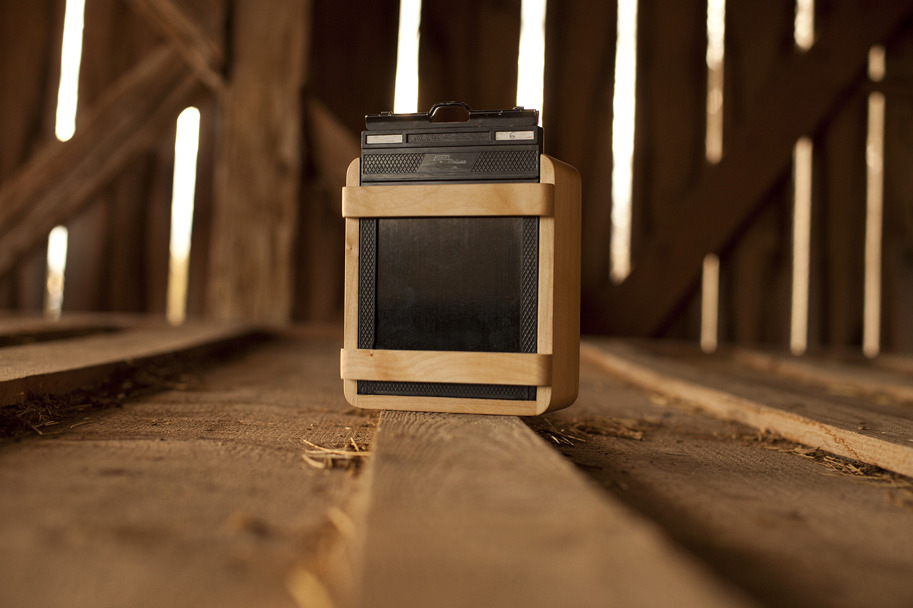
But a Slovenian artist is trying to take the art of photography back to its roots, with a series of wooden pinhole cameras. The ONDU pinhole cameras don’t use any electronics and are designed to last you a lifetime and even longer.


ONDU Pinhole Cameras Take Photo Art Back to Basics


Unlike regular cameras, pinhole cameras do not use any lenses. The images are produced through the cameras’ pin-sized holes: in order to expose the film, the user has to only move the shutter up. Because of the high aperture, the pinhole camera can produce impressive photo effects other lens based cameras cannot.


Elvis Halilović and his brother have been working on wooden pinhole camera designs for seven years, during which they were able to take pictures as large as 3 x 4 meters and as small so as to fit inside someone’s mouth.


Halilović created six different wooden pinhole camera models, which can work with all sorts of film, from 35mm to 4×5 inch or even larger paper. His cameras have a unique design: they are all handmade and there are no screws visible anywhere. The cameras are actually held together by strong magnets.


ONDU Pinhole cameras


The Slovenian artist said the main reason why he decided to make the pinhole cameras of wood is because he wanted them to be long-lasting. While most objects today become obsolete really fast and are replaced by next-generation models, Halilović wanted his pinhole cameras to be fully functional and durable enough to be passed on for generations.


The ONDU pinhole cameras are now on Kickstarter, where they have already exceeded their $10,000 crowdfunding goal by over $60,000. For different pledges, backers can get various ONDU models, from $60 for the ONDU 135 Pocket Pinhole to $200 for the ONDU Sliding Box Pinhole. The Slovenian brothers want to use the funds to improve the designs and get bulk order parts.


[Images via ONDU]


The post ONDU Pinhole Cameras Take Photo Art Back to Basics appeared first on TechBeat.


via TechBeat http://techbeat.com/2013/05/ondu-pinhole-cameras-take-photo-art-back-to-basics/?utm_source=rss&utm_medium=rss&utm_campaign=ondu-pinhole-cameras-take-photo-art-back-to-basics

Sticking to business can help Lenovo smartphones shine in the U.S.

[Software Update] Vivaldi 7.9 Minor Update (4) Released, Here is What’s New and Fixed

UPDATE: Release of Minor Update (4) for Vivaldi 7.9 stable version to public. Good news for Vivaldi browser users! Vivaldi team has released...