Let's Encrypt Everything

I'll admit I was late to the HTTPS party.

But post Snowden, and particularly after the result of the last election here in the US, it's clear that everything on the web should be encrypted by default.

Why?

  1. You have an unalienable right to privacy, both in the real world and online. And without HTTPS you have zero online privacy – from anyone else on your WiFi, from your network provider, from website operators, from large companies, from the government.

  2. The performance penalty of HTTPS is gone, in fact, HTTPS arguably performs better than HTTP on modern devices.

  3. Using HTTPS means nobody can tamper with the content in your web browser. This was a bit of an abstract concern five years ago, but these days, there are more and more instances of upstream providers actively mucking with the data that passes through their pipes. For example, if Comcast detects you have a copyright strike, they'll insert banners into your web contentall your web content! And that's what the good guy scenario looks like – or at least a corporation trying to follow the rules. Imagine what it looks like when someone, or some large company, decides the rules don't apply to them?

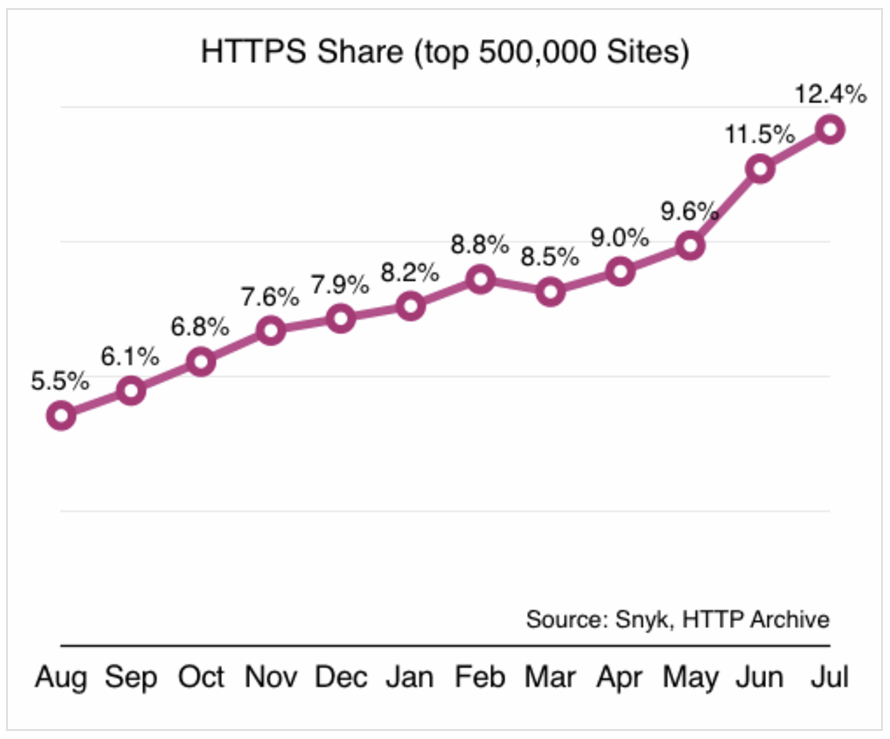
So, how do you as an end user "use" encryption on the web? Mostly, you lobby for the websites you use regularly to adopt it. And it's working. In the last year, the use of HTTPS by default on websites has doubled.
Browsers can help, too. By January 2017, Google Chrome will show this alert in the UI when a login or credit card form is displayed on an unencrypted connection:

Additionally, Google is throwing their considerable weight behind this effort by ranking non-encrypted websites lower in search results.

But there's another essential part required for encryption to work on any websites – the HTTPS certificate. Historically these certificates have been issued by certificate authorities, and they were at least $30 per year per website, sometimes hundreds of dollars per year. Without that required cash each year, without the SSL certificate that you must re-purchase every year in perpetuity – you can't encrypt anything.

That is, until Let's Encrypt arrived on the scene.

Let's Encrypt is a 501.3(c)(3) non-profit organization supported by the Linux Foundation. They've been in beta for about a year now, and to my knowledge they are the only reliable, official free source of SSL certificates that has ever existed.

However, because Let's Encrypt is a non-profit organization, not owned by any company that must make a profit from each SSL certificate they issue, they need our support:

As a company, we've donated a Discourse hosted support community, and a cash amount that represents how much we would have paid in a year to one of the existing for-profit certificate authorities to set up HTTPS for all the Discourse websites we host.

I urge you to do the same:

  • Estimate how much you would have paid for any free SSL certificates you obtained from Let's Encrypt, and please donate that amount to Let's Encrypt.

  • If you work for a large company, urge them to sponsor Let's Encrypt as a fundamental cornerstone of a safe web.

If you believe in an unalienable right to privacy on the Internet for every citizen in every nation, please support Let's Encrypt.

[advertisement] Find a better job the Stack Overflow way - what you need when you need it, no spam, and no scams.


via Coding Horror http://ift.tt/2gjy1sY

How Burnsville High School students create project-based learning

Editor’s note: As part of the ExploreEDU event series, schools are working with Google for Education Premier Partners to throw open their doors and invite neighboring educators to learn from their firsthand experience using Google tools to innovate and improve. To see if there is an event near you, visit the ExploreEDU site. For those that can’t join in person, we’ve asked the host schools to share their experiences and tips in a blog post. Today’s guest authors are Colleen Coleman and Anne Staum, teachers at Burnsville High School in the greater Minneapolis/St. Paul area. The district is hosting an event on December 1 and 2 with Best Buy for Education.

No matter the path our students take, the ability to guide their own learning will be an important part of their lives. At Burnsville High School, we’ve put students at the center of their education by transitioning from a lesson-based approach to a project-based one, introducing more personalized instruction and engaging students as active participants in their education.

We see technology as an essential tool in this evolution. Earlier this year, we introduced a 1:1 program schoolwide, which means all of our 2,700 students use Google Chromebooks in class and at home. We’re using tools like Chromebooks and G Suite for Education to ensure graduates are future-ready: comfortable with computing and online research, experienced in giving and receiving feedback, and confident creating content.

Here are a few ways we’re inspiring project-based learning in the classroom:

Boosting engagement with student-led content

We believe students learn best when they’re engaged as content creators. In our social studies classes, students use Chromebooks to research concepts like civic engagement and share their findings with the class. Teachers can gamify these lessons by offering extra credit to students who post the correct answer on Google Classroom, a tool that allows educators to communicate directly with students as well as manage assignments.

Our high schoolers are also using Chromebooks to work on in-depth projects and participate in learning experiences of their choice. A group of 12th graders produced a video about the founding fathers for American Government, while two juniors enrolled in a money management class recently placed second in a competitive stock market simulation, in which they virtual invested $100,000. Interdisciplinary projects like these immerse students in real-world topics while helping them develop critical skills, such as teamwork and planning.

Fostering civic inquiry

Chromebooks have helped our students better understand the world around them. Studying current events in our American government class, such as the presidential election, has encouraged students to question and critically examine their civic institutions. In a recent project, students researched competitive congressional races with their Chromebooks and organized their findings in Google Drive before presenting their findings to their classmates with Google Slides. We also used Slides to share the results of our school-wide presidential election. Without the easy-to-use tools in G Suite, it would have been much more difficult to conduct and share the results of our election simulation. These projects not only prepare students with practical knowledge that can inspire a budding passion, but also develop the analytical and presentation skills they will need to succeed as professionals.

Shortening feedback loops

Students tend to learn just as much from feedback as they do from completing an assignment.

In language arts class, for example, students need constant feedback to develop their writing. Teachers can give feedback while students are working on problems at home by collaborating in the same Google Doc. These fast feedback loops help students respond to input from teachers while it’s still fresh in their minds and fosters collaboration, another crucial real-world skill.

Today, project-based learning is inspiring our students’ curiosity and helping them identify topics they’re passionate about. We know it’s not easy to change ingrained approaches to teaching and learning, but it’s possible. It starts with encouraging students to imagine their path and direct their learning.


via The Official Google Blog http://ift.tt/2ghtiIu

[Changelog] What’s New in Google Chrome 140 and Later Versions

UPDATE: Addition of Google Chrome 147.0 version. In this exclusive changelog article, we are providing information about all versions of Goo...